
 34269976
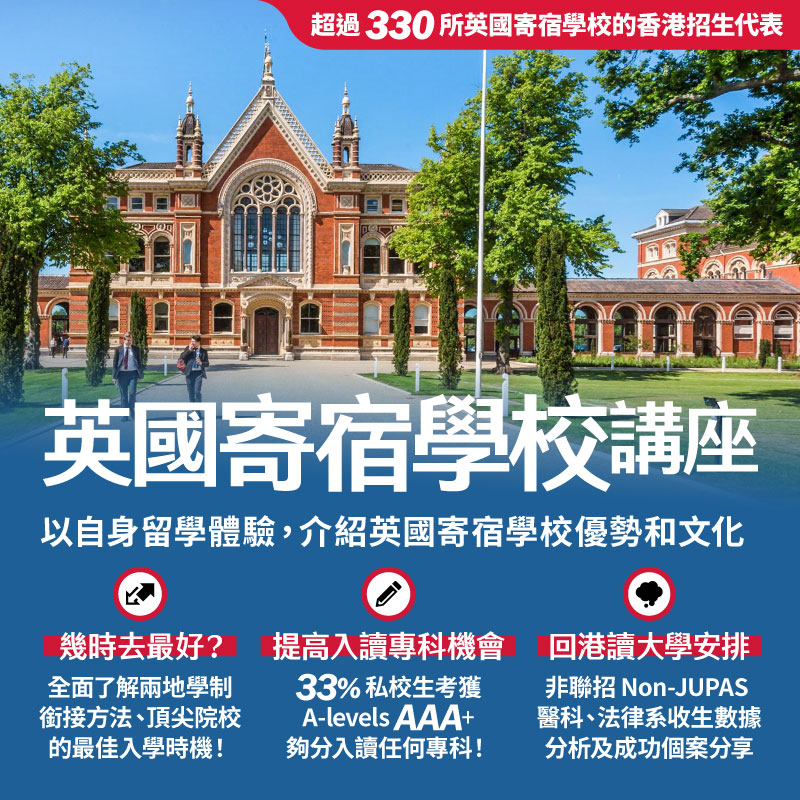
 10/10 英國寄宿學校講座
 中文版網站
中文版網站
 Your Education Pathway
Seminars and Interview Sessions
5:00PM - 6:00PM

A Smart City & Computer Science Seminar by University of Bristol: How can AI and Big Data Help Make Cities Smarter & Better?
As the worldwide trend of urbanization continues, 60% of the world’s population will live in cities by 2030. This means that in slightly over ten years’ time, close to 400,000,000 more people will move into cities in different part of the world. Cities need upgrades and improved efficiency to cope with such influx of people!
Taking advantages of the opportunities offered by information technology, Hong Kong and many cities around the world have started works to transform themselves into “Smart Cities”, in the hope to provide better living space and experience to citizens, and combat challenges (such as aging populations and air quality) made even more complicated in an increasingly urbanized and densely-populated space.
Content of Seminar
In the Seminar, Dr. Ivan Palomares Carrascosa, Lecturer in Computer Science from University of Bristol, will show us how a Smart City can look like and how it works from a more technological perspective. He will also share the experience of the Smart City initiative “Bristol Is Open” – a joint-venture between University of Bristol and Bristol City Council – to show us how things could look like when computer science is applied to urban planning.
This seminar in suitable for students and their parents, who have an interest in Computer Science, Urban Planning and other relevant academic disciplines.
- Smart City & the Challenges in an Increasingly Urbanized World:
Why is the concept of Smart City important? What challenges will our cities face in the future? Are cities not good enough? It turns out that there is room for improvement from lampposts and traffic lights to the information made available for citizens and businesses. - When Computer Science Becomes a Core Infrastructure:
From a technical point of view, Dr. Ivan Palomares Carrascosa will explain the computing system required for a Smart City to work. What roles can a computer scientist play in a Smart City project? How can artificial intelligence (AI) and big data help make cities smarter and better? - A “Smart City” Case Study from England:
In this section, Dr. Ivan Palomares Carrascosa will share the experience of the Smart City initiative “Bristol Is Open” – a joint-venture between University of Bristol and Bristol City Council. Since its establishment, “Bristol Is Open” has already kick-started a number of projects. In addition to early development works, University of Bristol is also the data hub of the project, where data collected from the city-wide network is transferred to and analyzed. The “Bristol Is Open” initiative was also considered a major contributing factor, when Bristol was named the number 1 Smart City in the UK! How did the University contribute to the project? How did the government facilitate it? And what benefits have the project offered citizens and businesses in Bristol? - A Computer Science Glossary:
After the Seminar, students and parents will have a basic understanding of some of the buzzwords in computer science, including Artificial Intelligence (AI), Big Data, Internet of Things (IoT), Machine Learning, Quantum Computing and more! - Course Introduction:
At the end of the Seminar, Dr. Ivan Palomares Carrascosa will briefly introduce the computer science programmes available in University of Bristol – BSc (Hons) Computer Science, MEng (Hons) Computer Science, MSc Advanced Computing (Machine Leaning, Data Mining & High-Performance Computing) and MSc Computer Science (Conversion) – covering areas such as course structure, professional qualifications, placement opportunities, facilities, etc.
University Profile: University of Bristol
| University Foundation Progress onto Year 1 of Degree |
International Diploma Progress onto Year 2 of Degree |
Undergraduate | Postgraduate |
| • | • | • |
Ranked the 44th globally (QS 18/19) and the 16th in the UK, also a Russell Group university, University of Bristol is a top research-intensive university located in the creative city of Bristol. As part of what reflects the good reputation of the University among middle-class families, about 40% of students of University of Bristol came from an independent school background, which is the fourth highest ratio, only after University of Cambridge, Oxford and St Andrew’s. Notable alumni include former British Prime Minister Sir Winston Churchill and singer-songwriter James Blunt, as well as Hong Kong alumni such as LegCo member Alvin Yeung Ngok-Kiu and news reporter Kenneth Ng King-Chun.
University of Bristol is ranked within top 10 in as many as 20 academic disciplines, which include highly popular courses such as Engineering, Law, Medicine and Veterinary Medicine, as well as Computer Science, Psychology, Geography & International Development, Politics, Sociology and Social Policy.
The Department of Computer Science, in particular, has a joint-venture with the city council of Bristol, which aims to employ artificial intelligence and big data technology to transform the city as a smart city. Since its establishment, this “Bristol Is Open” initiative has already kick-started a number of projects. In addition to early development work, University of Bristol is also the data hub of the project, where data collected from the city-wide network is transferred to and analyzed. To researchers and students in the University, this means that they have the whole city as their real-life case study and laboratory! The “Bristol Is Open” initiative was also considered a major contributing factor, when Bristol was named the number 1 smart city in the UK.
University Ranking
Engineering
Pharmacology
Engineering, Mechanical Engineering
Electrical & Electronic Engineering
Veterinary Medicine
Philosophy
You are registering for:
- Event: A Smart City & Computer Science Seminar by University of Bristol: How can AI and Big Data Help Make Cities Smarter & Better?
- Date: 14/3(Wednesday)
- Time: 5:00PM - 6:00PM
Seminars & Events




| Contact Us | ||
 |
Tel Address |
+852 3426 9976 info@britishunited.net 15/F, Belgian Bank Building, 721-725 Nathan Road, Mongkok (Mongkok MTR Station – Exit A1) |

